
Why might some neurodivergent people feel especially at ease around animals? In this personal reflection, a psychiatrist with ADHD explores how dogs’ direct affection, wordless communication and everyday routines can offer a sense of acceptance — while reminding us that animals have needs, boundaries and personalities of their own.
“The more I study man, the more I love the dog.”
— Victor Hugo
KEY TAKEAWAYS
- ❤The article explores the author’s personal sense that some neurodivergent people may feel especially understood around animals; it is not presented as a universal experience.
- ❤A dog’s direct affection and body language may feel less socially ambiguous than some human interactions.
- ❤Caring for a dog can bring everyday structure and draw attention back to the present through walks, feeding and other routines.
- ❤Time with animals may offer a break from the pressure some neurodivergent people feel to mask their behaviour or constantly explain themselves.
- ❤Dogs are individuals, not emotional-support tools; responsible care includes respecting their needs, preferences, boundaries and safety.
- ❤The article encourages us to treat behaviour as communication and to observe with curiosity before making judgments.
TABLE OF CONTENTS
A Personal Journey into the Human Mind
Throughout most of my adult life, I have been engaged in the study of human beings, their minds and emotions, and the treatment of mental illness. Neurodevelopmental conditions became my special interest after my CCT (super-speciality) in Adults with Intellectual Disabilities.
I decided to become a psychiatrist to study a wide range of topics, including minds, emotions, relationships, attachment, trauma, personality, behaviour, and the unusual ways in which people can love and hurt one another. I have spent thousands of hours listening to people explain why they did what they did, why they could not leave, why they could not stay, why they loved someone they resented, and why they destroyed something they had deeply wanted.
At some point in the process, I realised I understood dogs. Or maybe it was the dogs who understood me. It is said that Victor Hugo once said, “The more I study man, the more I love the dog,” and as I grow older, I come to appreciate the depth of that statement. I am neurodivergent, with ADHD, and I have lately begun to question whether the special affinity some neurodivergent people have for animals is purely coincidental. There is a wonderful simplicity to a dog.
The Simplicity of a Dog’s Affection
People communicate on several levels. It is common to say one thing while meaning another, and to mean one thing while saying another. There are hierarchies, conventions, rules of etiquette, expectations, concealed resentments, and social rules that everyone seems to have been given a handbook for, except in a few cases. It is expected that we should know when to speak and when to stop, how much interest to show, what level of enthusiasm is acceptable in society, and when honesty has crossed the mysterious line into “too much”.
Dogs show very little interest in any of these things. A dog is happy to see you and acts as if this is the most important thing in the universe. One need not feel embarrassed about being enthusiastic.
One of the reasons I love them may well be this: a mind wired for ADHD can feel enthusiastic. If something catches our interest, we do not always handle it politely. Instead, we rush in. We read everything we can find about it. We talk about it. We think about it at two o’clock in the morning. We draw connections others sometimes cannot see. We end up fascinated, absorbed and, at times, obsessed. Then the world asks us to cut back. Dogs are just as bad at toning things down as we are.
See a dog welcoming someone it loves. The whole animal is brimming with emotion. The tail does not just wag; the whole body does. There is jumping, spinning, vocalising, running away, then racing back again. It is emotion without embarrassment. There is something magnificent about that. Maybe people who have, for years, been told that they are “too intense” see a reflection of their own intensity in animals, since those animals have never learned to apologise for it.
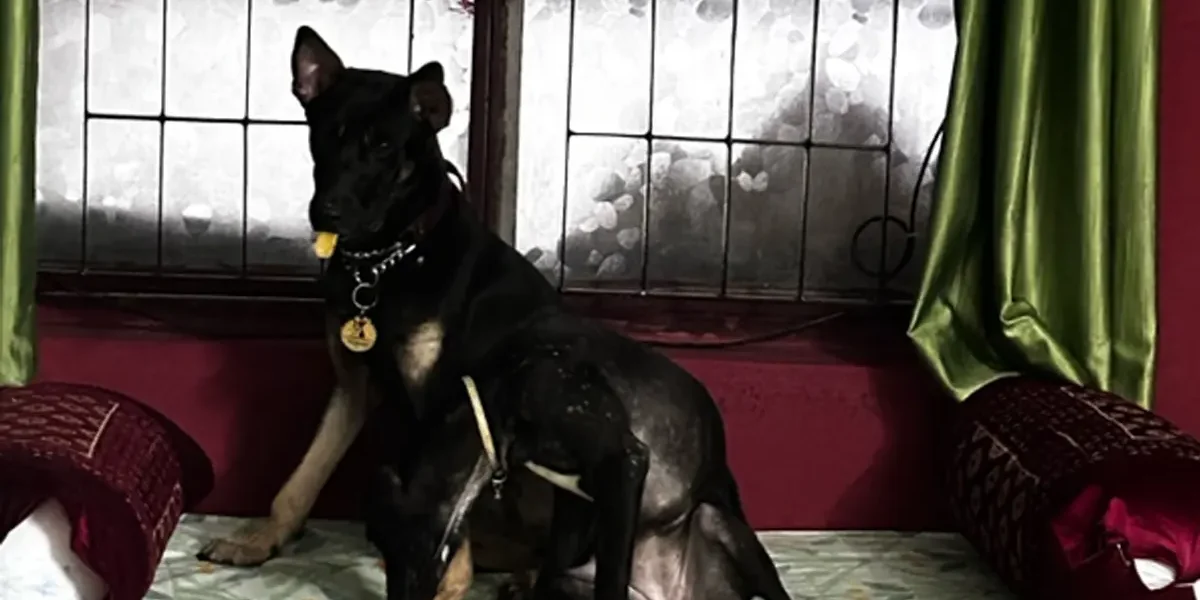
My dogs, Nilavan and Rita, have told me this over and over again. They do not need the more refined version of me. A psychiatrist is not necessary. They are not concerned with my qualifications, my writings, my speeches, my professional identity, or the fact that I have replied to every message on my phone. They care whether my executive functioning was excellent that morning.
Communication Beyond Words
My dogs know something even more basic. They know my footsteps. They know my voice. They notice when I leave the room and know when I have come back. I know them just as well. Living with dogs teaches you a language with very few words:
a certain look
the position of the tail
a sudden stillness
a paw placed on you
a head leaning against your leg
the clear invitation to play
the equally clear request to be left alone
There is communication everywhere. It is by no means human communication. And perhaps that matters.
Neurodivergent people are often described in terms of their social naivety. They are said to miss social cues, interrupt others, become distracted, talk too much, retreat, experience hyperfocus, forget people’s birthdays, reply to messages three days later, and sometimes give a twenty-minute answer to a question that takes only twenty seconds.
Attention is not the same as love
Social fluency does not equate to empathy
From an external perspective, these behaviours may be perceived as a lack of care. But attention is not the same as love, and social fluency does not equate to empathy. Remembering to reply on WhatsApp does not indicate the depth of someone’s emotional life. Some neurodivergent individuals feel emotions with exceptional intensity. They may be acutely sensitive to suffering and injustice, which can feel almost unbearable.
When Intensity and Vulnerability Are Misunderstood
An injured animal by the roadside is not merely background. A frightened puppy is not merely another person’s issue. A hungry dog sitting outside a shop may stay in one’s mind long after everyone else has passed by. I believe this is one reason animals become so closely tied to the lives of some neurodivergent people: their vulnerability is direct.
There is no social puzzle to be solved. A dog that is thirsty, frightened or injured needs care. A dog that is alone needs company. There is a kind of moral purity in this simplicity.
Human relationships can vary greatly and often need to be interpreted.
THE QUESTIONS THAT LOOP IN THE MIND
What did she mean? Why did he say that? Why has this person stopped replying? Was that affection, an attempt at manipulation, politeness, a sense of obligation or resentment? Should I call? Should I wait? Have I said too much? Was I too intense?
A person whose mind is neurodivergent can find themselves caught in such questions. It is rare for a dog to leave you uncertain about the meaning of its tail wagging for three days.
Dogs Bring Us Back to the Present
Animals offer another gift: they can bring us back into the physical world. A differently wired brain can be present in yesterday, tomorrow and seventeen unfinished ideas.
A dog lives now. The walk is now. The odour on the pavement is now. The ball is now. Dinner is definitely happening now. There can be something grounding about another creature repeatedly bringing you back to the present moment. It is not possible to intellectualise life when someone is next to you with a leash in their hand.
Dogs establish structure without first holding a committee meeting about it. They have to be fed, taken outside, engaged with and cared for. For people who find it difficult to create routines on their own because of challenges with executive functioning, another living being can provide an external rhythm.
→
Open the door
→
Feed us
→
Come outside
→
Look at this
→
Throw that
→
Come home
→
Rest
→
Repeat tomorrow
There is a deeply calming quality to these little rituals. There is also the sense of touch: a warm body next to you, fur under your hand, the weight of a dog’s head pressing against you, the steady rhythm of breathing, and the odd comfort of another mammal deciding that the most suitable spot in the house is the one nearest to you.
A Space Where We Do Not Have to Mask
No explanation is required. This matters because neurodivergent people often spend much of their lives explaining themselves. Why did you forget? Why were you late? Why did you interrupt? What makes you so emotional? Why do you speak so loudly? Why are you so absorbed in this? What prevents you from organising yourself? What makes you act this way?
Eventually, even a very strong individual can get tired of explaining. Nilavan does not ask me to explain my brain. Rita does not need to draw up a diagnostic formulation before deciding whether I am worthy of her affection.
For a short time, animals can allow us simply to exist. I believe another factor may be at play: masking. Many neurodivergent adults become highly skilled at appearing “normal”. We are taught how long to maintain eye contact, when it is appropriate not to interrupt, to restrain our movements, to rehearse conversations, to monitor our volume and to hide our boredom. We are taught to seem calm even when our minds are working at an extraordinary speed. Some people become so proficient that the effort goes unnoticed.
Around a dog, there is no need to perform:
- ✔️ You can pace.
- ✔️ You can talk to yourself.
- ✔️ You can sing nonsense.
- ✔️ You can cry.
- ✔️ You can sit in silence.
- ✔️ You can become deeply excited about an idea.
- ✔️ You can spend half the afternoon sorting things out, only to give up halfway through when a new idea comes to you.
The dog shows remarkably little moral judgement when watching humans’ odd behaviour. That freedom can be a relief.
Loving Animals Means Respecting Their Needs
I do not want to sentimentalise animals. Dogs are not furry antidepressants and can hardly be described as emotional-support machines put on Earth for human convenience. They are individuals.
They feel afraid and become frustrated; they have their own preferences and boundaries. They need:
🩺
Veterinary care
🍖
Adequate nutrition
🏃
Exercise
🎓
Training
🧩
Enrichment
🛡️
Safety
Some dogs are difficult, some are reactive, and others are exhausting. Loving animals means taking responsibility for their well-being rather than simply enjoying what they offer us.
In fact, this may be one of the healthiest aspects of loving an animal. The relationship is not completely about you. Even when your dog seems to be in charge, you still need to regulate yourself to look after it. You need to observe another nervous system.
What Dogs Can Teach Us About Behaviour
You learn patience and observation. You discover that shouting does not teach effectively, and that fear is not the same as stubbornness. You come to realise that behaviour has causes. Rather strangely, dogs might make us better psychiatrists, because at its best psychiatry asks precisely the same question.
NOT
“What is the matter with you?”
INSTEAD, TRY
“What is the behaviour attempting to communicate?”
Behaviour can be understood as a form of communication before it is interpreted as a diagnosis:
- ✔️ A dog may bark because it is frightened.
- ✔️ A child who is overwhelmed might scream.
- ✔️ A person with ADHD might interrupt.
- ✔️ An autistic person may withdraw.
- ✔️ A person who has been traumatised may become hypervigilant.
We are reminded to remain curious before forming judgments.
Belonging Without Having to Fit In
The lesson extends far beyond animal behaviour. It reaches humanity as well. Perhaps that is the paradox contained in Victor Hugo’s observation: the more I get to know humans, the more I love dogs. Yet the more deeply we love dogs, the more compassionately we may learn to understand people.
Dogs teach us to notice rather than assume, to observe rather than judge, and to respect nervous systems that are different from our own. Fear can appear as aggression, excitement as disobedience, overwhelm as defiance, and love can be shown in unconventional ways. These are lessons psychiatry needs, and society needs them too.
Nilavan and Rita will never encounter the term neurodivergence. They do not need to. What they know predates psychiatry. They know attachment. It may be for this reason that some neurodivergent people feel deeply at home among animals.
Many neurodivergent people are asked whether they fit comfortably into the human world. Are we organised enough? Quiet enough? Predictable enough?
“A dog does not ask whether you suit the world. It simply makes room for you among its own.”
Sometimes, that is one of the purest forms of belonging we will ever know: the neurodivergents.
SEEKING SPECIALIZED CARE?
Expert Adult ADHD Treatment at Chennai Minds
Dr. Radhika Murugesan brings extensive expertise to the diagnosis and management of adult ADHD and related neurodevelopmental conditions, ensuring tailored treatment plans for optimal outcomes.
Frequently Asked Questions
Why might some neurodivergent people feel connected to dogs?
The article suggests that a dog’s direct affection, observable body language and limited reliance on complicated social conventions may feel easier to navigate for some people. This is the author’s reflection, not a claim that all neurodivergent people experience the same connection.
Can caring for a dog help create a daily routine?
As described in the article, feeding, walking and caring for a dog can provide an external rhythm to the day. The article presents this as a possible everyday benefit, not as a substitute for clinical care or as a treatment recommendation.
Are dogs simply emotional-support tools for people?
No. The article explicitly stresses that dogs are individuals with their own fears, preferences and boundaries. They need proper care, exercise, nutrition, veterinary attention, enrichment and safety. A loving relationship includes responsibility for the animal’s well-being.
What does it mean to view behaviour as communication?
It means pausing before judging behaviour as rude, stubborn or defiant and considering what it might express. The article encourages observation and curiosity — for example, recognising that fear or overwhelm may affect how a person or animal behaves.
Written and Medically Verified by Dr. Radhika Murugesan, MBBS, MRCPsych | Consultant Psychiatrist